A Short-Lived Career in Journalism
- Elsa Kenningham
- Jun 16, 2023
- 5 min read
Updated: Jan 31, 2024
It’s 9:29 and I arrive at the cafe on Walworth Road, sweating. I sit outside to wait, hoping it will evaporate.
“You don’t have any sort of weird milk, do you?” My interviewer says hurriedly, as she smacks her contactless against Louie Louie's innocent card machine.
“You’ve got a languages degree from a really top, top university. You’re clearly smart.” My stomach twists; I opt not to mention that my highest mark from this year was for a podcast about urban foxes, and my dissertation analysed German rap music videos. “What I need is another Lucy [my older sister, who set up this interview]. Thank God your parents had two of you.” I wonder whether to point out that we are mere siblings, rather than clones.
She asks about my year abroad. I mention that I worked at a potato hotel changing beds and mopping. “Don’t tell me you were a maid?” she interjects, ending my happy reminiscensing (enjoy some of the hotel's artwork below).





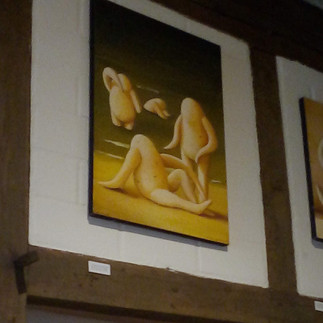
Following my confused silence, she launches into an explanation of the magazine's business model in more detail than could possibly have been necessary, dropping names and acronyms which I don’t bother to try and figure out.
Two hours pass, in which I say very little but react, artificially, to everything she says in my direction. We stand up to leave, and she starts to talk about where I will be working. I say I’m flexible so she suggests she show me her office, whisking me out of the cafe and into the street. On the way to her house, I ask about how the pandemic has affected her kids, just to make conversation.
“Claudia, she’s my eldest, she’s just been, you know, at her computer before I am in the morning. You know, she’s won the LAMDA prize, the drama prize, you know. She’s always fine. Hugo, my other one, he’s now at Kingsdale. It’s okay, like Graveney, enough middle class families have moved into the catchment area that it’s decent. We moved them from his very jujjy prep school in September (he’s not very academic). I’m not familiar with the state school system: we got him a key worker space because of his Dad’s job [Tory MP]. At his old school that meant he was hanging out with the kids of doctors, and barristers, but obviously he’s fallen in with a bad lot at this new school. He’s becoming a bit of a rebel.” Go Hugo, I think, as we climb the steps to her double fronted house and enter what she refers to as the ‘drawing room’.
I find myself perched on her stiff, leather sofa, receiving the lowdown on her daughter’s pandemic experience. “They’re horizontal borders, not vertical, so it’s just been a hotbed of hormonal issues. Self harm: it's an epidemic,” she says, crinkling her forehead but failing to look remotely concerned. “That’s not something a 14-year-old should have to be dealing with,” I nod enthusiastically, “reporting that girls have been using scissors to cut themselves. She’s resilient but I’m sure it will damage my Claud in the long term.” Then she opens her tiny laptop and starts to type angrily while I try to look busy, thinking: why the fuck am I here?
There is a crisis at the magazine: an interview has been set up for the next edition but without an interviewer in mind. They need five to seven questions by the end of the day, so my personal interviewer rings up and shouts at whoever it is that set up and fucked up their interview.
While she's flinging herself into yelling at another colleague about how angry she is at the person she has just been speaking to, her husband enters the drawing room. “I obviously thought straight away of the CEN” [the Conservative Environmental Network, I have since looked it up] “but we’ve got one of them interviewing someone else already, and this is supposed to be a cross-party magazine.” She turns to me energetically, her disarmingly thick auburn hair swinging over her shoulder and her eyes glittering, “wouldn’t it be fabulous if we could have Caroline Lucas interview her?”
“Caroline Lucas is too extreme,” her husband says in a bored tone. He is sitting in an uncomfortable-looking, overstuffed William Morris armchair opposite me, without ever looking in my direction. “I mean she’s not an extremist, but…” I wonder if this moderation is for my benefit.
“You haven’t done anything with the environment, have you?” I don’t think now is the time to mention that I was an active member of the XR and had been hoping to do some form of Workaway on a farm this summer, rather than writing bios about politicians who have already been written about enough to qualify for their places on Iain Dale’s Top 100 list.
Some painful hours of me writing the urgently needed interview questions later, her daughter comes in. Like her father, she doesn’t seem able to notice my presence and instead starts drawling to her mother, who interrupts, shouting, “you’ve got a stain on my top! That’s a new stain! It wasn’t there before!”
“It’s white, so it’s easy to get out. We can just treat it,” says her daughter lazily, but still with crisp pronunciation of her ts.
“I’ve had that jumper for thirty years! I can’t believe you’ve done that! It’s make up isn’t it, you’ve got makeup on my white jumper.”
“Can we please just take a chill pill,” the daughter says, unironically. “It’s milk. It’s milk from my Coco Rocks.” The name sounds incongruous among the sophisticated drawing room decor.
“Coco Rocks!?” Her mother cries in horror. “Where did you get those from? Get out right now and go and put it by the washing machine.”
At 2:30pm my new boss (of several hours — I assume there's an unspoken contract since I'm literally doing work for her already) is downstairs in her kitchen. I hear her shout up: you haven’t had anything to eat!
I descend, feeling self conscious in my squeaky employ-me boots. She swerves round the corner: “I should eat something, the caffeine from this morning’s just hitting [she can only mean the flat white that she drank six hours previously]. I’m getting a bit hyper!” My eyebrows raise inadvertently, and I hope that I don’t look too visibly nonplussed.
She empties the contents of her fridge onto the large wooden kitchen table, pointing at things and calling them words that I have never heard before. “The rhubarb is from our house in the country, it’s really very nice.”
“I’m sure you’re familiar with the Aga set-up: boil, simmer, 200 degrees, 150 degrees,” she says, pointing at its various chambers. “Not very environmentally friendly, I know, ha ha.” I think she says this because the next magazine is themed: environment, and she has been telling me of its importance. She laughs very hard and I find it hard to match.
While I awkwardly chop the mushrooms for a lunch I'm now cooking myself in her kitchen (she's declined my counter offer of a portion), I ask her about her career and how she came to be a journalist to fill the silence. She launches into a 15 minute spiel, pausing after the occasional triumph to console me that “of course, that’s just how things were back then!” (She got a mortgage at 25.)
“I mean, there are benefits to working from home,” she gesticulates at the clock and her bowl, madly. “I mean, I’m able to eat a grapefruit in my kitchen at 3pm!” I look up from my sad meal of mushrooms on unbuttered toast and pessimistically scan her eyes for any trace of humour.

Comments